The next step: from blue to green hydrogen production in Rotterdam
A new milestone in the energy transition is underway in the Port of Rotterdam: the realization of a green hydrogen production plant. The project follows on from the previously published article Building sustainable hydrogen in Rotterdam and shows how the region continues to develop into the center of hydrogen technology in Europe.
Our colleague Lidiia Danishevska is involved in construction here as contract manager. We spoke to her about her role, progress and her personal experience within this special project.
From ammonia to hydrogen
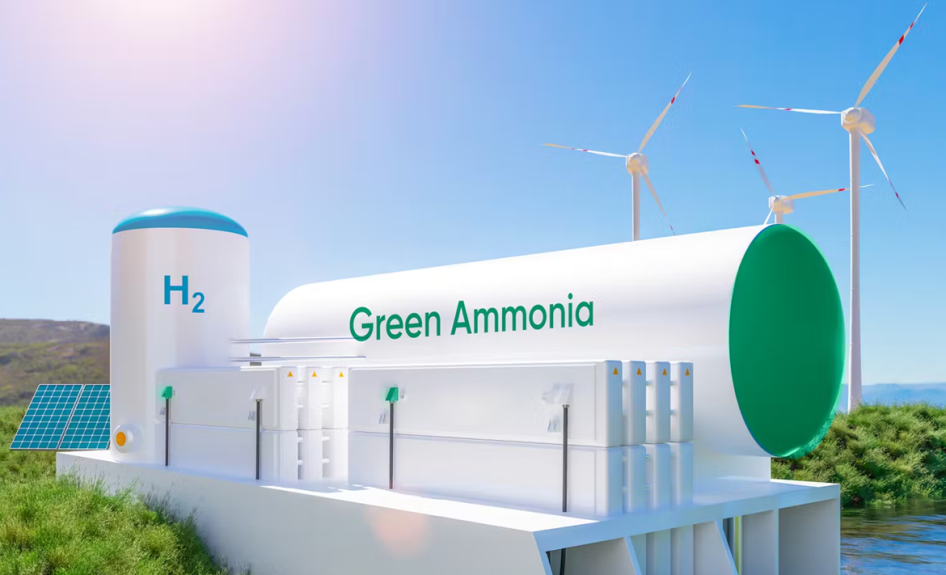
Whereas previous projects still focused on blue hydrogen and carbon capture, this project focuses entirely on green hydrogen. In the Middle East, hydrogen is produced using solar and wind energy. This is then converted into ammonia so that it can be safely transported by ship. In the Port of Rotterdam, the ammonia is converted back into hydrogen, which then finds its way through Europe via pipelines.
Lidiia explains: “In this process, no CO₂ free. It is a completely sustainable chain from production to distribution. That's what makes this project so special.”
Construction in full swing
Work at the port is now at an advanced stage. The civil foundations have been completed and the assembly of the steel structures is also largely complete. Large, prefabricated modules from Asia were placed on six-meter-high foundations using heavy cranes. A logistical feat that was carried out with extreme precision. Lidiia looks back on this phase with pride: “The modules are up to forty meters long and already equipped with pipes and cable routes. Everything had to be installed with extreme precision, which made the work challenging and interesting.”
With the completion of the so-called heavy elevator campaign the project reached an important milestone. This phase required close coordination between the various disciplines, with safety constantly at the forefront.
The role of a contract manager
As contract manager, Lidiia plays a central role in working with the various contractors and partners. She monitors planning, quality and budget, but above all she ensures a connection between all parties.
“Contract management is not just about documents. It's about communication, understanding and trust. At the end of the day, people make the difference.”
The project team consists of hundreds of professionals spread across several locations. Because of the complexity, good collaboration from design to implementation is crucial.
Flexibility and forward thinking
As with many large-scale projects, plans are adjusted during implementation. For example, some parts, such as the planned tank storage, have been modified to better utilize existing infrastructure. Lidiia sees these changes not as obstacles, but as part of the process. She explains that any large project requires flexibility, moving with the times and thinking ahead: “Every change brings challenges, but also opportunities. We adapt and think in terms of solutions. That's part of the business.”
According to her, the strength of a good team lies in its ability to remain flexible without losing focus. When cooperation is good, any obstacle can be overcome.
Women in industry
The construction site mainly employs men, but the proportion of women is constantly growing. Lidiia sees this as a positive development:
“There are a small number of women on site, but we are visible and involved. This work is not about being male or female, but about professionalism.”
She emphasizes that in addition to technical knowledge, people skills are also indispensable in her profession. According to her, contract management is as much about understanding and respect as it is about strategy. Ultimately, it's about knowing how to work with people, she says: “You don't negotiate with papers, you negotiate with people.”
Building the future together
Rotterdam's green hydrogen facility represents an important step in making industry more sustainable. The project brings together technology, innovation and international cooperation and shows how tangible the energy transition now is.
Lidiia articulates it beautifully: “We are building something here that goes beyond one project. It's part of a global movement toward a cleaner future and I'm proud of that.”
At BENK PROJECTS, we are proud that professionals like Lidiia are contributing to this development. Her story shows that progress is not only about technology, but more importantly about the people who make it possible.